Polski
 Українська
Plaster removal price per m2 in 2026: example room with rubble disposal
indekscen.pl editorial team · published 30 September 2026 · prices according to the 5 October 2026 index
Removing old plaster in Poland most often costs 70 PLN/m² for labour alone, with half of all quotes falling within 58 ‑ 73 PLN/m². For large jobs, from around 120 m², the rate falls to approximately 30 PLN/m². Removing plaster from the walls of a 16 m² room, around 40 m² of wall area, costs PLN 2,800 at the median rate, excluding rubble disposal.
At a glance (as at 5 October 2026)
- Removing old plaster in Poland usually costs 58 ‑ 73 PLN/m² for labour alone, with a median of 70 PLN/m².
- For large jobs involving around 120 to 150 m² of plaster, the removal rate falls to approximately 30 PLN/m².
- Removing plaster from the walls of a 16 m² room, around 40 m² of wall area, costs PLN 2,800 in labour at the median rate.
- The plaster removal price does not include rubble disposal: a small rubble skip costs around PLN 240.
- The median plaster removal price is based on 3 price lists and articles collected by indekscen.pl.
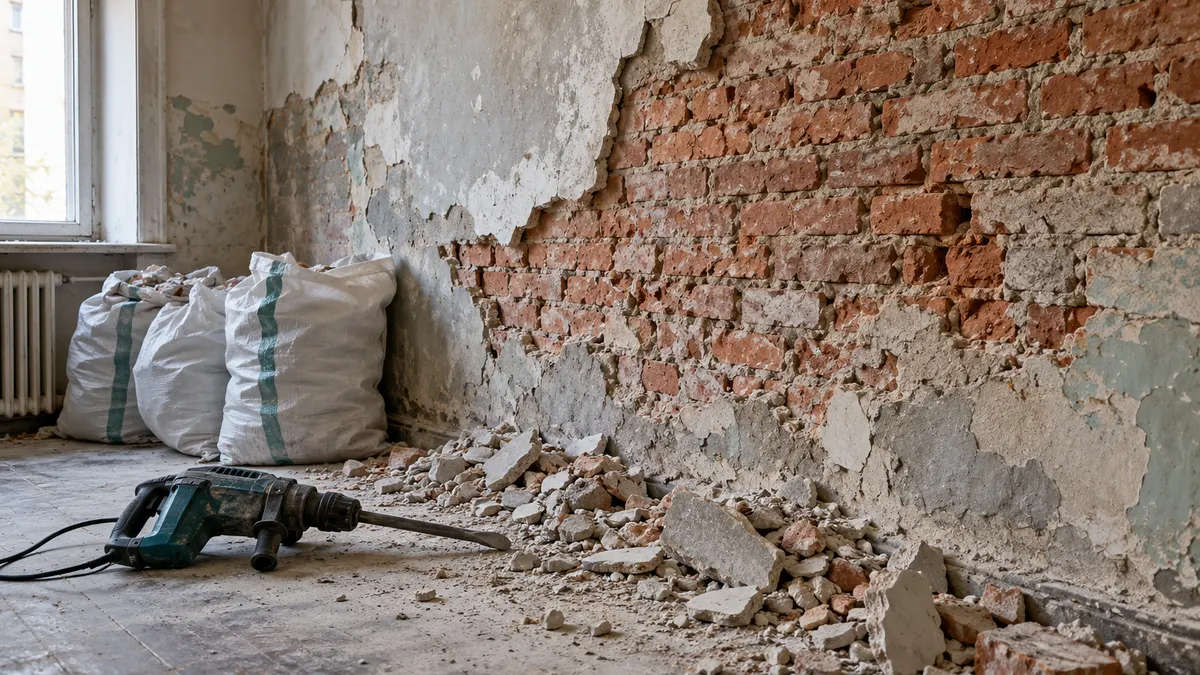
Plaster removal is one of the messiest renovation jobs and one of the hardest to estimate by eye. The rate per square metre may look modest, but the bill rises once rubble disposal, new plaster and skim coating are included. We present rates from contractors’ price lists and calculate the cost for an example room and flat. We also explain when old plaster can be left in place, because the cheapest plaster removal is the work you do not need to do.
Plaster removal: price per m2
Removing old plaster most often costs 70 PLN/m² for labour, according to 3 price lists and articles collected by indekscen.pl. Half of all quotes fall within 58 ‑ 73 PLN/m², the lowest start at 35 PLN/m², and the highest reach 105 PLN/m². For large jobs involving around 120 to 150 m², the rate can fall to approximately 30 PLN/m².
The price covers only removing and collecting the old plaster from the wall. Rubble disposal, bags, protective sheeting and tape for securing the room are usually charged separately. Contractors often quote net prices, so ask for the price including tax when comparing quotes. Details and sources are available at removing old plaster.
| Removing old plaster: option | Median | Typically | Sources |
|---|---|---|---|
| Basic service | 70 PLN/m² | 58 ‑ 73 PLN/m² | 3 |
| larger jobs (120-150 m² of plastering, lower price) | 30 PLN/m² | 30 PLN/m² | 1 |
Median and typical range from public price lists, as at 5 October 2026. Each price includes a source and quotation on the service page.
What affects the cost of plaster removal?
The cost of plaster removal depends primarily on how firmly the plaster adheres to the masonry and what it is made from. Brittle lime or cement-lime plaster in an old tenement building often comes away in sheets, while hard gypsum or cement plaster has to be chipped off piece by piece.
Factors that increase the rate:
- Hard plaster with good adhesion, especially cement and gypsum plaster.
- Ceilings, arches, cornices and reveals rather than flat walls.
- Careful work around brickwork that is to remain exposed.
- A small job. For just a few square metres, the contractor charges a minimum fee for travel and preparation.
- A large city. Rates in Warsaw or Kraków are usually higher than in smaller localities.
Example: how much does plaster removal cost in a room and a flat?
Removing plaster from the walls of a 4 by 4 m room with a height of 2.6 m, around 40 m² of wall area after subtracting the window and door, costs PLN 2,800 in labour at the median rate, typically PLN 2,300 ‑ 2,900. A 50 m² flat usually has around 130 m² of walls requiring plaster removal, giving a median cost of PLN 9,100, but for an area of this size it is worth negotiating the large-job rate of around 30 PLN/m².
Removing the plaster is only the beginning. The following items apply to a room with around 40 m² of wall area:
| Item | Cost for approx. 40 m² of walls | Notes |
|---|---|---|
| Plaster removal, labour | PLN 2,800 | typically PLN 2,300 ‑ 2,900 |
| New internal plaster, labour | PLN 1,800 | materials not included |
| Gypsum skim coating, labour | PLN 1,900 | primer not included |
| Small rubble skip (1 to 1.5 m³) | around PLN 240 | depending on plaster thickness |
We do not add these amounts together because each comes from different price lists and changes independently. A 16 m² room usually produces between 0.5 and 1 m³ of rubble if the plaster is 1.5 to 2 cm thick, so a small skip or several bulk bags will be sufficient.
| Service | Median | Typically | Sources |
|---|---|---|---|
| Removing old plaster | 70 PLN/m² | 58 ‑ 73 PLN/m² | 3 |
| Wall plastering | 44 PLN/m² | 40 ‑ 51 PLN/m² | 4 |
| Gypsum skim coating | 48 PLN/m² | 46 ‑ 54 PLN/m² | 6 |
| Skip for rubble | PLN 800 | PLN 675 ‑ 890 | 3 |
Median and typical range from public price lists, as at 5 October 2026. Each price includes a source and quotation on the service page.
How much does rubble disposal after plaster removal cost?
Rubble disposal after plaster removal costs from around PLN 240 for a small skip to PLN 800 for a skip of around 5 m³. The price shown at removing old plaster almost never includes disposal, so this item must be budgeted for separately.
Pay attention to the type of waste: companies treat plaster mixed with wood, plastic sheeting or bags as mixed waste, and mixed waste (instead of clean rubble) costs around PLN 550. You should therefore keep plaster rubble separate from other renovation waste. rubble removal in bulk bags may be cheaper for small quantities. Read more in the article rubble skip: price list.
Should old plaster be removed?
Old plaster needs to be removed if it is falling off, damp, affected by salt deposits, cracked across the entire surface or sounds hollow when tapped. It does not need to be removed if it is hard, dry and firmly attached: in that case, it is enough to repair any damaged areas and apply a skim coat for 48 PLN/m² in labour instead of paying 70 PLN/m² for removal and then applying new plaster.
A simple test is to tap the wall with a hammer handle. A hollow sound means that the plaster has detached from the masonry and will eventually fall off. If there are only a few hollow areas, they can be removed locally. If most of the wall sounds hollow, removing all the plaster will be cheaper than patching it.
How can you remove plaster from a wall yourself?
You can remove plaster from a wall yourself using a demolition hammer with a flat chisel, or even an ordinary hammer and cold chisel if the plaster is brittle. Hiring a demolition hammer usually costs 86 ‑ 110 PLN/day, so doing the work over a weekend can save a significant amount on labour. You should still account for your own time: a professional can strip a room in one or two days, while an amateur will usually take longer.
Work in the following order:
- Protect the room: place protective sheeting on the floor and doors, use tape, and switch off the power to sockets on the wall being stripped.
- Wear protective equipment: safety glasses, a dust mask, gloves and hearing protection.
- Work from top to bottom, holding the chisel at a shallow angle to the wall to avoid damaging the masonry.
- Collect the rubble as you work in bags, because after a few square metres the floor will become impassable.
- Finally, clean the masonry with a wire brush to remove any remaining mortar and dust before applying new plaster.
Is exposed brick after plaster removal a good idea?
Exposed brick after plaster removal is a good idea when the wall is made from solid, even bricks in good condition, which is mainly found in old tenement buildings. Removing plaster to expose brick is then more expensive than ordinary removal, closer to 105 PLN/m², because the contractor has to work carefully to avoid chipping the brick faces and then clean the joints.
Before commissioning the exposure of an entire wall, remove a test section measuring roughly 1 m². It often turns out that the wall contains different types of brick, filled-in openings, concrete block patches or cables in chases. Once the plaster has been removed, the brick still needs to be cleaned, the joints repaired and the surface sealed to prevent dust. If you are not satisfied with the result, you can always apply plaster again, but you will then pay for both removal and replastering.
Plaster removal or plasterboard?
Instead of removing the plaster and replastering, walls can sometimes be covered with plasterboard, but this solution only makes sense if the walls are dry and sound. The boards reduce the room by several centimetres and do not solve damp problems. Damp plaster or plaster affected by salt deposits must be removed, and the cause of the damp must be dealt with before new plaster is applied.
We discuss the cost of new plaster in more detail in the article how much does plastering a house cost, and the overall cost of the work in how much does renovating a flat cost. You can find all finishing-work prices in the renovation and finishing category.
„Skuwanie tynku kosztuje od 45 do 105 złotych za metr kwadratowy, ale ostateczna cena zależy od przyczepności warstwy do muru, rodzaju tynku i skomplikowania powierzchni.”
adrem.org.pl, 2025, source
„Średnio za usunięcie tynku zapłacimy około 45 zł/m² netto. Najtańsze oferty zaczynają się od 35 zł/m² netto, a przy przeciętnym poziomie trudności górna granica wynosi 55 zł/m² netto.”
porownajocieplenie.pl, 2025, source
„Skuwanie starego tynku, 55,00 zł/m2, 85,00 zł/m2”
kb.pl, 2025, source
The prices in this article come from contractors’ public price lists and construction articles. Each price on the removing old plaster page includes a source, date and verbatim quotation.
Frequently asked questions
How much does removing old plaster cost?
Zerwanie starego tynku kosztuje zwykle 58 ‑ 73 PLN/m² robocizny, a najtańsze oferty zaczynają się od 35 PLN/m². Przy zleceniach powyżej 100 m² stawka za metr bywa niższa, około 30 PLN/m².
How much does removing plaster from a ceiling cost?
Skuwanie tynku z sufitu jest droższe niż ze ścian, bo praca nad głową jest wolniejsza i wymaga rusztowania. Osobnej mediany dla sufitów nie mamy, ale takie zlecenia są wyceniane bliżej górnej granicy 105 PLN/m².
How much does removing external plaster cost?
Skuwanie tynku z elewacji wycenia się zwykle indywidualnie, bo dochodzi rusztowanie, zabezpieczenie otoczenia i wywóz dużej ilości gruzu. Stawki za m² ściany są porównywalne z wewnętrznymi, 58 ‑ 73 PLN/m², lub wyższe przy trudnym dostępie.
How long does it take to remove plaster from a room?
Skucie tynku ze ścian jednego pokoju zajmuje ekipie zwykle od jednego do dwóch dni, zależnie od twardości tynku. Robocizna za około 40 m² ścian to po medianie PLN 2,800.
Should plaster be removed before replacing the electrical wiring?
Tak, skuwanie tynku planuje się przed kuciem bruzd i wymianą instalacji, bo potem ściany i tak trzeba otynkować od nowa. Dzięki temu nie płaci się dwa razy za naprawę tynku.
Check prices with sources
Every amount quoted in the article has a source, date and verbatim quote from the price list on the service page.
Translation of the original Polish article dated 30 September 2026. Quotations from price lists are in Polish, as published by the companies. Read the original in Polish.
Found an error? Report it. Do you provide these services? Add your company's price list free of charge.